Legislative library home page
Legislative Reference Library of Texas
your partner in legislative research

New & Noteworthy List for July 2015

The Library is continually adding new books to its collection. Below are the six titles from our July 2015 New & Noteworthy list.
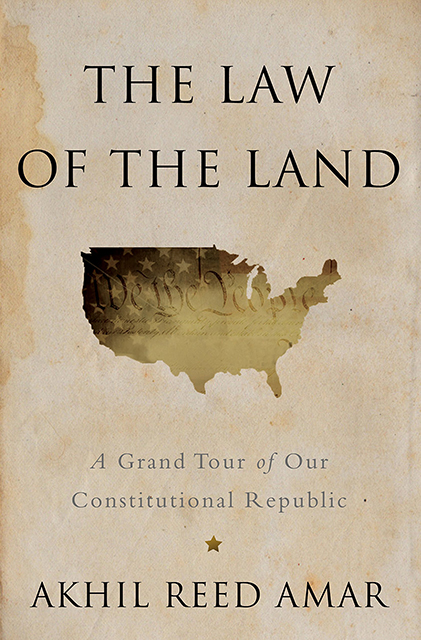


Book Cover Image 1. The Law of the Land: A Grand Tour of Our Constitutional Republic By Akhil Reed Amar
Tells a national story of the United States Constitution through the window of individual states and regions on issues such as civil rights and the Second Amendment. Argues that states are "legal and political building blocks" for federal institutions and ideas. Offers a "Lone Star view" of presidential selection and succession in a chapter on Texas, including the "JFK-LBJ Amendment" after the Kennedy assassination, the presidencies of George H.W. Bush and George W. Bush, and the 2016 presidential campaign.
Basic Books, 2015. 357 pages. 342.73 AM13 2015
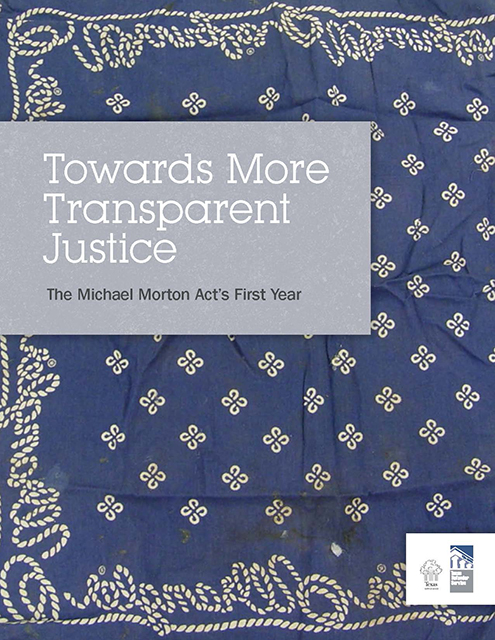

Book Cover Image 2. Towards More Transparent Justice: The Michael Morton Act's First Year By Texas Appleseed and Texas Defender Service
Evaluates the implementation of the Michael Morton Act with a goal of discovering any obstacles to a defendant seeking access to discovery material. Seeks to identify best practices that may help ease the transition process for district and county attorney offices. Discovers a number of issues with implementation of the Act but notes resolution should come as offices streamline their processes for reviewing and prosecuting cases and defendants litigate their access to specific materials.
Texas Appleseed, 2015. 47 pages. Online at: http://texasdefender.org/wp-content/uploads/Towards_More_Transparent_Justice.pdf 345.73 T65M 2015
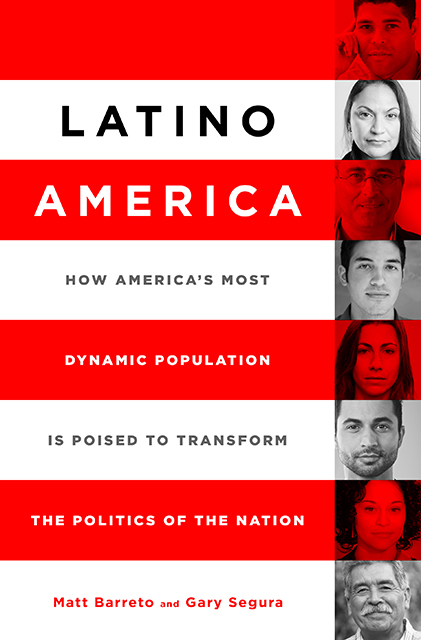

Book Cover Image 3. Latino America: How America’s Most Dynamic Population is Poised to Transform the Politics of the Nation By Matt Barreto and Gary M. Segura
Evaluates how a growing Latino population, which will inevitably become the majority racial/ethnic group in many states, including Texas, will affect social issues, both culturally and politically. Analyzes the growing role that Latinos play in the changing American political landscape. Explores diverse attitudes among Latinos on social, governmental, and economic issues, and argues against a tendency to regard Latinos as a homogeneous group, especially when it comes to politics.
PublicAffairs, 2014. 286 pages. 323.1 B275 2014


Book Cover Image 4. The State of the States in Intellectual and Developmental Disabilities By David L. Braddock, et al.
Provides a state-by-state breakdown of funding and services provided to individuals with cognitive disabilities. Highlights data regarding the number of people residing in public and private institutions (focusing on the trend of some states closing state-run institutions), funding levels for community services and supports, and factors driving demand for services among different populations. Includes state profiles detailing information on persons by living setting, sources of funding (funding/state/local), and fiscal effort (institutional services v. community/family services). Offers an argument for increased funding to enhance access to technology for individuals with cognitive disabilities in the appendix, “The Rights of People with Cognitive Disabilities to Technology and Information Access".
American Association on Intellectual and Developmental Disabilities, 2015. 217 pages. 362.4 B729S 2015
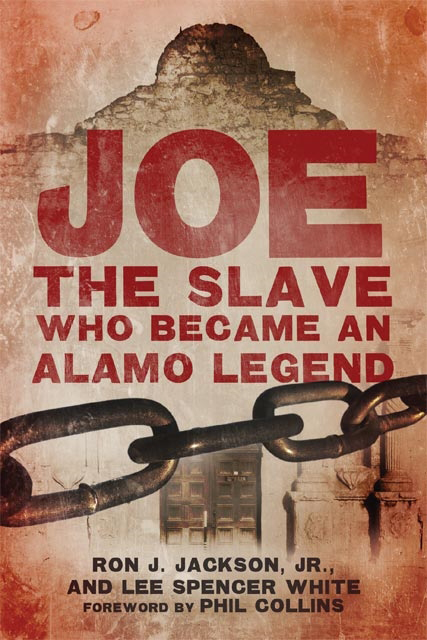

Book Cover Image 5. Joe the Slave Who Became an Alamo Legend By Ron Jackson Jr. and Lee Spencer White
Provides a fascinating new perspective on a survivor of the battle of the Alamo who has remained in relative obscurity. Chronicles the life of Joe, Colonel William Travis’ slave, who was released by Santa Anna, told his story to the Texas Cabinet, and disappeared. Discusses new evidence that Joe was the brother of a famous abolitionist, William Wells Brown, and the grandson of Daniel Boone.
University of Oklahoma Press, 2015. 325 pages. 976.4 J137 2015
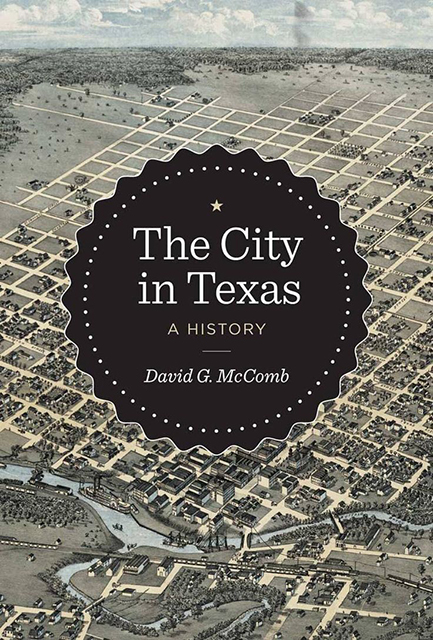

Book Cover Image 6. The City in Texas: A History By David G. McComb
Presents Texas history from an urban point of view, placing the development of Texas cities within their historical context, and identifying how they developed the necessary ingredients of survival: access, purpose or reason for being, and water. Demonstrates how the Texas shift from rural to urban is essential to understanding the state's history and its contemporary character. Emphasizes that 88 percent of Texans live in cities, compared with 82 percent of the United States as a whole, and that these cities have been incubators of innovation and achievement.
University of Texas Press, 2015. 342 pages. 307.76 M134C
Highlights From Our Collection


The library is always adding new books to its collection. Previewed below are six books recently added.

Reimagining Courts: A Design for the Twenty-First Century, by Victor E. Flango and Thomas M. Clarke (2015).
"[This book] recommends a triage process based upon case characteristics, litigant goals, and resolution processes. Courts must fundamentally reorganize their business processes around the concept of the litigant as a customer." (Website)

American Nations: A History of the Eleven Rival Regional Cultures of North America, by Colin Woodard (2011).
"In [this book the author] takes readers on a journey through the history of our fractured continent, offering a revolutionary and revelatory take on American identity, and how the conflicts between them have shaped our past and continue to mold our future." (Website)

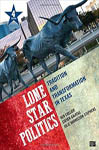
Lone Star Politics: Tradition and Transformation in Texas, by Ken Collier, Steven Galatas, and Julie Harrelson-Stephens (2015).
"[This book] delves deeply into Texas’ rich political tradition, exploring how myth often clashes with the reality of modern governance. Explaining who gets what and how, this Nacogdoches author team uses the comparative method to set Texas in context with other states’ constitutional foundations, institutions, electoral practices, and policymaking." (Website)

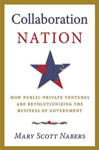
Collaboration Nation: How Public-Private Ventures Are Revolutionizing the Business of Government, by Mary Scott Nabers (2012).
"[The author] focuses on how to transfer resources from government to the private sector and outlines alternatives that are emerging in cases where government can no longer maintain its functions at or below cost. In her view, outsourcing has often been the best method." (Website)

American Sniper: The Autobiography of the Most Lethal Sniper in U.S. Military History, by Chris Kyle; with Jim DeFelice and Scott McEwen (2013).
"In moving first-person accounts throughout, Kyle's wife, Taya, speaks openly about the strains of war on their marriage and children, as well as on Chris. Adrenaline-charged and deeply personal, [this book] is a thrilling eyewitness account of war that only one man could tell." (Website)

Heads Above Water: The Inside Story of the Edwards Aquifer Recovery Implementation Program, by Robert L. Gulley; foreword by Andrew Sansom (2015).
"They had tried many times to resolve their differences about how to conserve, allocate, and use the water, but had always failed. Finally … 39 diverse stakeholders reached a consensus on the use of the Edwards Aquifer that balanced the needs of south central Texas for water with the needs of eight species protected by the Endangered Species Act." (Website)


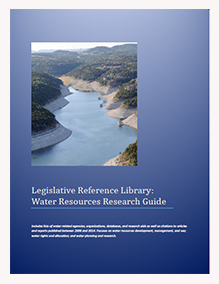
Texas Water Resources Research Guide

Cover image for the Water Resources Research guide Looking for a starting point to research Texas water issues?  Check out the Legislative Reference Library's new Water Resources Research Guide
 
This comprehensive bibliography of resources related to water includes lists of water-related agencies, organizations, databases, and research aids as well as citations to articles and reports published between 2008 and 2014.
 
The Guide focuses on water resources development, management, and use; water rights and allocation; and water planning and research.

New to the LRL: Texas State Cemetery book

  Texas State Cemetery The recently published Texas State Cemetery highlights the history of the state cemetery and the noteworthy Texans who are buried there. Established by an act of the Texas Legislature in the winter of 1851, the cemetery has become the final resting place for hundreds of notable Texans, from military and political figures such as Stephen F. Austin and Edwin Waller, to cultural figures like J. Frank Dobie and Tom Landry. The first individual to be buried in the cemetery was Edward Burleson, veteran and vice president of the Republic of Texas, who died unexpectedly in 1851 in Austin. He remained the lone occupant of the cemetery for four years until Abner Smith Lipscomb, a lawyer, veteran, secretary of state during the Mirabeau B. Lamar administration, and Texas Supreme Court justice, died and was buried near Burleson's grave in 1856. Biographical information and photographs for Burleson and many other individuals who are buried in the cemetery are provided in the book, divided into chapters on the Republic of Texas and the Civil War, public officials, cultural figures, educators, and Texas Rangers.

You can learn more about the Texas State Cemetery and the individuals who are buried there by looking at the cemetery website and also by searching the cemetery database.

The library's two copies of this book can be viewed by visiting the library and may be checked out by members of the legislative community.
 

New Acquisition: Juvenile Mental Health Courts

Juvenile Mental Health Courts   One of the library's recent acquisitions, a report published by the Houston nonpartisan advocacy group Children at Risk, takes an in-depth look at Texas' new juvenile mental health courts. These specialty courts are designed to aid juvenile offenders who suffer from mental illness. Their focus is on treatment and rehabilitation rather than incarceration.

The report, Texas Juvenile Mental Health Courts: An Evaluation and Blueprint for the Future, begins with a concise overview of these specialized systems. It then focuses on four major courts in Austin, El Paso, Harris County, and San Antonio. For each court, the researchers describe the process juvenile offenders go through, the services the court offers, and the potential outcomes of a case. They also provide demographic and offense statistics. Finally, each court is evaluated on success rates and cost-effectiveness. Individual case histories are included throughout this section, adding a personal touch to the numbers.

The report's second section lays out a "blueprint for the future." After a brief overview of the advantages of juvenile mental health courts, the authors offer specific, detailed guidance to policymakers and local leaders who are considering establishing these courts in their communities. The discussion takes readers step-by-step through the process of setting up a mental health court system and is punctuated with real-world examples from the courts described in section one.

The authors conclude with policy recommendations from various stakeholders and Children at Risk itself. These recommendations address funding, staffing, and evaluation concerns. Along with the rest of the report, they provide a good starting point for those interested in learning more about this new breed of specialty court.

New Water Conservation Report

An Assessment of Aquifer Storage and Recovery in Texas  Water conservation is a perennial topic in Texas, and a report newly added to our collection this week examines the potential for storing water in underground aquifers, a type of storage known by water experts as aquifer storage and recovery, or ASR. Published by the Texas Water Development Board, the report describes how El Paso Water Utilities, the city of Kerrville, and the San Antonio Water System are utilizing ASR technology.

According to the report, ASR has proven to be an efficient and cost-effective method of storing water compared to the use of surface reservoirs, however Texas is lagging behind other states in the implementation of ASR. It points out that at the present time, less than 4 percent of the nation's operational ASR wellfields are located in Texas, although other fast-growing states such as Florida and California are actively pursuing this technology.

The report concludes that the principal challenges for ASR are primarily the legal and regulatory frameworks which, in many states, have not yet caught up with the application of the ASR technology. It points out that although there is a solid regulatory and legal foundation in Texas, improvement and enhancement of the rules and statutes both at the state and local levels are needed. The report makes specific recommendations for legal and/or regulatory changes, and includes several other recommendations that could enhance the implementation of ASR in Texas.

Previous Entries